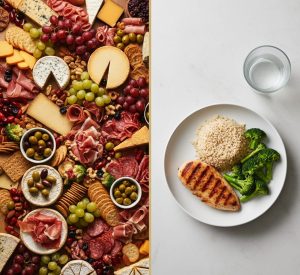
If your weekdays look like kale and your weekends look like chaos, this study might explain why the scale keeps creeping back up.
Let me paint a picture you might recognize.
You’re incredible Monday through Thursday. Protein and vegetables. Reasonable portions. You track everything. You feel virtuous, controlled, like you’ve finally cracked the code.
Then Friday afternoon arrives and something shifts. You’ve been “so good” all week. You deserve a break. A few drinks with dinner. Maybe some dessert.
Nothing crazy—you’re still being reasonable, right?
Saturday morning brings brunch. Sunday? Meal prep goes out the window because life happens.
Monday morning you step on the scale and you’re up two pounds. You tell yourself it’s just water weight. You’ll be strict again this week.
The cycle continues.
If this pattern sounds familiar, you’re not failing at weight loss. You’re succeeding at weight regain.
And a massive study of nearly 1,500 successful weight loss maintainers just revealed why this approach—the one that feels balanced and sustainable—is actually working against you.
The One Stat You Should Remember
People who eat roughly the same way seven days a week are 1.5 times more likely to maintain their weight loss than people who diet strictly on weekdays and loosen up on weekends.
That’s it. That’s the whole thing.
Not more restriction. Not more willpower. Not some complex meal timing strategy or 47-step morning routine.
Just consistency. Boring, unsexy, seven-days-a-week consistency.
The Truth Behind the Numbers
The National Weight Control Registry is basically the hall of fame for weight loss maintenance. To get in, you have to have lost at least 30 pounds and kept it off for at least a year.
These aren’t people starting their first diet. They’ve already won the hard part.
Researchers wanted to know what separated the people who stayed successful from those who slowly drifted back up the scale.
So they asked a simple question: Do you eat the same way throughout the week, or do you diet more strictly on weekdays than weekends?
Then they tracked 1,429 people for a full year to see what happened to their weight.
The results were stark. The more consistent someone’s eating pattern across the week, the less weight they regained.
This wasn’t a subtle difference. It was clear and linear.
The people who maintained their weight within 5 pounds? They were eating roughly the same way whether it was Tuesday or Saturday.
The people who regained weight? They were operating in two modes: weekday restriction and weekend freedom.
Think of it like a leaky bucket. The weekday-weekend crowd had a bigger leak. Not a flood. Just a persistent drip that added up over twelve months.
The researchers found the same pattern with holidays.
People who maintained similar eating patterns year-round kept their weight off.
People who were strict most of the year and loose during holidays regained more weight.
Here’s what matters: the successful maintainers weren’t eating “perfectly.” They just weren’t swinging wildly between restriction and relaxation.
What Cheat Days Really Do to Your Weight Loss Goals
Let me be clear about what this study is and isn’t saying.
It’s not saying you need to eat the exact same meals every day for the rest of your life. It’s not saying you can never have a celebratory dinner or enjoy birthday cake.
What it is saying: The bigger the gap between your “diet days” and your “off days,” the harder it becomes to maintain your weight loss.
A few extra drinks Friday, a heavy brunch Saturday, and a relaxed Sunday don’t feel like much in isolation. But they repeat. Over months, those calories add up.
Think about a thermostat. You set it to 60 degrees Monday through Friday because you’re trying to save money.
Then you crank it to 80 on the weekend because you’ve been freezing all week and you deserve to be comfortable.
Your heating system is constantly working overtime trying to adjust. It’s inefficient and exhausting.
But if you just set it to 70 and leave it there? Everything runs smoothly.
Your body works the same way. When you swing from restriction to freedom and back again, you’re asking your metabolism, hunger hormones, and eating habits to constantly recalibrate.
It’s exhausting for your body and your brain.
The people who succeed long-term have found their 70 degrees. And they stay there, regardless of what day it is.
4 Reasons Why Inconsistent Eating Habits Fail
Several forces work against you here. And they all reinforce each other.
1. The psychological trap. When you restrict hard during the week, you’re telling yourself that your normal eating pattern is punishment. The weekend becomes the reward.
You’ve created a cycle that guarantees you’ll feel deprived Monday through Friday and out of control on Saturday and Sunday.
And here’s the thing about permission—it creeps. “I earned this” can gradually turn into more treats, bigger portions, and longer indulgence windows.
2. The physiological response. Restriction increases hunger hormones like ghrelin (that’s the hormone that makes you feel hungry).
So when the weekend arrives and the guardrails come off, you’re not just dealing with “I want to relax.” You’re dealing with genuinely amplified hunger signals.
Your body is trying to recover from what it perceives as scarcity. Big swings in intake can make hunger and cravings worse, not better.
3. The brutal math. Say you maintain a 500-calorie deficit Monday through Friday. That’s 2,500 calories below maintenance for the week. Sounds great, right?
But then you eat 800 calories over maintenance on Saturday and Sunday. You’ve just wiped out 1,600 of those 2,500 calories.
Your actual weekly deficit? 900 calories. That’s barely a quarter pound of fat loss per week.
And here’s the kicker: over time, those weekend numbers creep up. Suddenly you’re at maintenance or even a slight surplus for the week, despite feeling like you were “good” most of the time.
Weekend calories are real calories. They don’t vanish just because it’s Saturday.
4. The habit problem. When you practice two different eating patterns, you never fully master either one.
The consistent eater has built habits that run on autopilot. A steady routine becomes automatic and doesn’t rely on willpower.
The weekday-weekend eater is constantly switching between two different systems. Neither becomes automatic. Swings require constant effort and decision-making.
Debunking Diet Consistency Misconceptions
Myth #1: You can never eat differently on weekends.
Wrong. What matters is the size of the difference. Having an extra slice of pizza on Saturday is not the same as treating the entire weekend as a free-for-all.
The goal is to narrow the gap, not eliminate every variation.
Myth #2: Consistency means perfection.
Nope. Consistency means your Tuesday looks similar to your Saturday. Not identical. Similar.
You can be consistently flexible. You can be consistently moderate. The key is that your general approach doesn’t dramatically shift based on what the calendar says.
Consistency doesn’t mean never enjoying yourself. It means making your enjoyable moments predictable and compatible with your goals so they don’t become a slow leak.
Myth #3: Cheat days boost your metabolism.
This is a popular idea, but it’s not reliably true. Any small metabolic uptick from a higher-calorie day won’t cancel out the extra calories you’ve consumed. The math doesn’t work in your favor.
Myth #4: Weekend weight gain is just water weight.
Sometimes it is. But when the pattern repeats week after week, that repeated excess turns into fat. You can’t blame water forever.
Myth #5: Extreme weekday restriction cancels out weekend indulgence.
Rarely. Extreme swings are hard to sustain and they wear you out mentally and physically. They also set up that deprivation-compensation cycle that makes the weekend feel like an emergency.
Myth #6: Successful weight loss maintenance requires a joyless, monotonous existence.
This is the big misconception. The successful maintainers in this study weren’t miserable robots eating plain chicken breast every day.
They’d figured out a way to eat that allowed for pleasure and satisfaction seven days a week.
They weren’t swinging between deprivation and indulgence. They were living in the middle zone all week long.
That’s not boring. That’s freedom.
Practical Steps to Eliminate Cheat Days and Keep Weight Off
Enough theory. Here’s what you do.
1. Pick a realistic baseline.
Choose a daily eating pattern you can follow most days of the week. Make it simple. Make it something that includes foods you actually enjoy. This is your foundation.
For the next seven days, don’t change anything—just observe and take notes. Write down roughly what you eat each day.
Then rate each day on a 1-10 scale for “how different was this from my typical weekday eating?”
If your weekend days consistently score 7 or higher, you’ve found your problem.
2. Calculate your weekend drift.
If you track calories or macros, pull up your data. Look at your average weekday intake versus your average weekend intake.
If there’s more than a 20-25% difference, that gap is undermining everything you’re doing Monday through Friday.
3. Move toward the middle (not toward more restriction).
This is crucial. The solution is not to restrict harder during the week. It’s to eat more flexibly Monday through Friday and more intentionally on Saturday and Sunday.
If you’re eating 1,500 calories on weekdays and 2,800 on weekends, the answer isn’t to drop to 1,200 on weekdays. It’s to bring weekdays up to maybe 1,700 and weekends down to around 2,200. Find your sustainable middle.
4. Plan one real treat each weekend.
Instead of treating the entire weekend as a free-for-all, decide on one treat that truly matters to you. Schedule it, enjoy it fully, then move on.
This gives you something to look forward to without derailing your entire weekend.
5. Sprinkle in pleasure throughout the week.
If you’re saving all your “fun” foods for the weekend, you’re guaranteeing the cycle of deprivation and compensation.
Have the small dessert on Tuesday. Go out for happy hour on Thursday. Make Wednesday dinner something you actually look forward to.
Spread the enjoyment across all seven days instead of cramming it into 48 hours.
6. Anchor your weekends with routine.
Keep one or two core habits steady even on weekends—protein at breakfast, a vegetable at dinner, or a simple meal prep ritual.
These anchors stabilize the day without making it feel restrictive.
Most people plan weekday meals but wing it on weekends. Flip that approach. Plan Saturday and Sunday meals with the same level of thought you give to meal prep Sunday.
Structure doesn’t mean rigidity. It means you’re making intentional decisions rather than reactive ones.
7. Prep something easy.
A ready-to-go salad base or batch of cooked protein reduces impulse choices when you’re tired or hungry. Simple prep gives you options that don’t require willpower.
8. Set limits on liquid calories.
Alcohol and sugary drinks pile on calories fast. Set a simple maximum—maybe two drinks at social events—and stick to it. Liquid calories are easy to underestimate and they add up quickly.
9. Kill the “cheat day” language.
Stop calling it a cheat day. Stop calling it a free day. Stop calling it your “off day.”
Words shape thinking. If you’re calling Saturday your cheat day, you’re telling yourself that your normal eating is punishment and Saturday is the reward.
Instead: “I eat in a way that supports my goals seven days a week, with natural variation.”
10. Use the Tuesday test.
You’re at brunch on Saturday and you’re eyeing the French toast with a side of bacon, hash browns, and a mimosa.
Before you order, ask yourself: “Would I eat this exact meal, in this exact amount, on a random Tuesday?”
If the answer is “absolutely not,” you’re not making a choice—you’re in weekend mode.
11. Practice portion control in social settings.
Share plates, order half portions, and eat slowly. These small adjustments let you participate in social meals without overdoing it.
12. Reset kindly when things go off track.
If you overdo it at one meal, plan a nourishing dinner and a steady next day.
No punishment. No guilt. No making up for it with extreme restriction. Just get back to your baseline.
13. Rethink holidays and vacations.
Same principle, bigger time scale. Instead of treating Thanksgiving through New Year’s as a six-week free-for-all, identify which specific meals actually matter to you.
Thanksgiving dinner? Sure. Christmas morning breakfast with your family? Absolutely. Random Tuesday work party in mid-December with grocery store cookies? Maybe skip it.
Make indulgence predictable. If you know you’ll have a big holiday meal, plan lighter meals earlier that day rather than treating it as an all-day permit.
Stay consistent around the peaks instead of using them as permission to abandon structure for weeks at a time.
From Cheat Days to Consistency: A Patient’s Journey
I had a patient who lost 27 pounds using the weekday-strict, weekend-relaxed approach. She felt like she’d found balance.
But over the next year and a half, she slowly regained 10-15 pounds despite “being good” most of the time.
We switched to a different approach: one planned weekend treat, simple meal prep, and a two-drink limit at social events. She kept her social life. She kept her sanity. And she kept her weight off.
The difference wasn’t sacrifice. It was predictability.
Why I Changed My Mind About Cheat Days
When I first came across this research, I wanted it to be wrong.
I’d spent years telling myself—and my patients—that successful weight management requires “balance.” And in my head, balance meant eating strictly during the week and loosening up on weekends was a good option. It felt sustainable while avoiding obsessiveness.
But the more I sat with this data, the more I realized I’d been equating balance with oscillation.
Balance is steady. Oscillation is swinging back and forth between extremes.
The people who keep significant weight off for five, ten, fifteen years don’t live in two different worlds.
They’ve just found their sustainable middle ground and they live there.
It’s less dramatic than the typical diet story. There’s no “before and after” when it comes to their weekly rhythm. No grand narrative about willpower and sacrifice.
And that’s exactly why it works. The absence of drama is the whole point.
When your baseline is solid and similar across the week, the occasional deviation doesn’t matter. You absorb it and move on.
But when you’re constantly swinging between extremes, every deviation feels like a crisis. Every weekend feels like damage control. Every Monday feels like starting over.
That’s not sustainable. That’s exhausting.
What This Cheat Day Research Does and Doesn’t Prove
This study isn’t perfect, so let’s talk about where it falls short.
First, these participants had already successfully lost weight and maintained it for at least a year. They’re not representative of everyone struggling with weight. They’re the success stories.
It’s possible that consistency is easier for this group because they’ve already developed strong habits. Beginners might see different effects.
Second, the study measured how consistently people ate, not what they ate. So we don’t know if the consistent eaters were also making other smart choices that contributed to their success.
Third, this is observational research, not a controlled experiment. The researchers didn’t randomly assign people to eat consistently or inconsistently. They just tracked what people were already doing.
That means it shows a link, not proof that consistency causes better outcomes.
Participants also reported their own behaviors, which can be imperfect. So we can’t say with 100% certainty that consistency causes better weight maintenance.
But here’s why I still think this matters: the relationship was strong, it was consistent, and it aligns with everything we know about habit formation and how our bodies adapt to patterns.
The behavior science behind this makes sense: repeated small choices beat sporadic extremes.
Taking Action: From Cheat Days to Diet Consistency
Start small. Don’t overhaul your entire life this week. Pick one thing.
- Maybe it’s having a structured breakfast on Saturday morning instead of skipping it and then demolishing the brunch buffet at noon.
- Maybe it’s planning Sunday dinner with the same intention you bring to Wednesday dinner.
- Maybe it’s setting a two-drink limit at weekend social events.
- Maybe it’s allowing yourself dessert on Tuesday so you’re not saving all your “treats” for the weekend.
Pick one thing and try it for a month.
Watch what happens. Not just on the scale, but in how you feel.
Notice whether the Monday morning “reset” feeling starts to fade. Whether you feel less deprived during the week and if weekends feel less chaotic and more normal. Pay attention to how your clothes fit, not just what the scale says.
The goal isn’t perfection. It’s not even strict consistency.
The goal is to narrow the gap between your “on” days and your “off” days until the distinction barely exists.
Because here’s what the study showed: the people who succeed long-term aren’t the ones with the most willpower or the strictest diets.
They’re the ones who’ve figured out how to eat in a way that doesn’t require willpower—because it’s just how they eat, every day, regardless of what the calendar says.
You can be one of those people. Just make your weekdays a little more enjoyable and your weekends a little more intentional.
You don’t need to be perfect to succeed. You need predictability. Plan your pleasures so they don’t undo your work.
That’s practical. That’s doable. And it’s kinder to your willpower.
Stay Connected for More Studies and Strategies
If this resonates with you and you’re serious about making this weight loss thing work, I want to help.
Every week, I send out an email breaking down the latest research on weight management and metabolism. No fad diets. No miracle exercises. Just evidence-based strategies that work in the real world.
Some weeks I challenge conventional wisdom like I did today. Other weeks I confirm what you already suspected but needed the data to back up. Sign up now.