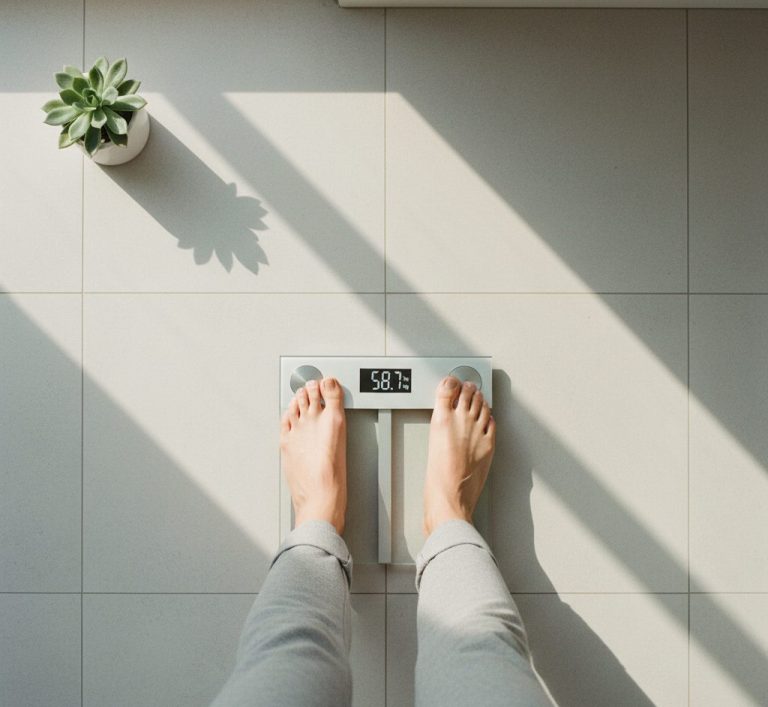
I’m going to make a case for something that makes a lot of people uncomfortable, but the data won’t let me ignore it.
What if you had a dashboard for your weight maintenance? Something that could alert you to problems before they became serious, giving you time to course-correct with minimal effort?
You do. It’s that scale you’ve been avoiding.
I know—you’ve been told that frequent weighing creates anxiety, obsession, unhealthy fixation. But what if that advice, however well-intentioned, is costing you your progress?
This study of 3,000 successful weight losers shows how stepping on a scale—and what you do with that information—creates a feedback loop that separates long-term success from slow regain.
The Bottom Line
Here’s what matters:
People who stop weighing themselves regularly gain about 9 pounds over a year.
People who maintain or increase how often they weigh? They gain less than half that.
This isn’t about becoming neurotic. It’s about creating an early warning system.
Think of your scale like the check engine light in your car. It doesn’t fix the problem. But it tells you there is one before your engine seizes at 70 mph on I-95.
Or think of it like glancing at your bank account. You don’t do it because you’re obsessed with numbers—you do it because you want to avoid overdraft fees.
What the Research Found
Researchers tracked over 3,000 members of the National Weight Control Registry. These are people who’d lost at least 30 pounds and kept it off for at least a year.
These are not crash dieters who dropped weight last month. Success stories. The ones who figured something out that most people don’t.
At the start, more than a third of these successful maintainers stepped on the scale every single day. The daily weighers had lower BMIs.
They also scored higher on two measures: cognitive restraint (the conscious effort to control eating) and disinhibition (the tendency to lose control around food).
Before you panic—both scores stayed in healthy ranges.
These weren’t people white-knuckling through life or secretly bingeing on Oreos in their cars. They were not OCD or eating disordered.
They were just more aware.
Then researchers followed up a year later. They split people into three groups based on what happened to their weighing habits.
- The Decreasers weighed themselves less often than before. Average weight gain: 8.8 pounds.
- The Maintainers kept their weighing frequency the same. Average weight gain: 4 pounds.
- The Increasers weighed themselves more often than before. Average weight gain: 2.4 pounds.
Same year. Same group of successful losers. Wildly different outcomes based on one behavior.
It’s the difference between noticing your car pulling slightly to the left versus waiting until your tires are bald. A quick course-correct early on saves you from bigger problems later.
And here’s where it gets interesting.
When people decreased how often they weighed themselves, they also reported eating more fat, losing control around food more often, and using less conscious restraint.
The scale wasn’t just tracking weight change—it was tracking all the behaviors that drive weight change.
But even when researchers controlled for those other behaviors, decreasing weigh-in frequency independently predicted weight regain.
Stepping away from the scale, by itself, mattered.
What This Means for You
Let me be direct: the scale is information, not judgment.
When you step on it regularly, you’re not being obsessive. You’re being strategic. You’re collecting data about a system that doesn’t come with a dashboard otherwise.
Without that data, you’re flying blind.
Imagine trying to save money without ever checking your bank account. You just swipe your card and hope for the best.
Sometimes you feel broke, so you cut back. Sometimes you feel flush, so you splurge.
What happens? You overdraft. You rack up fees. You never know where you stand until you’re already in trouble.
Your weight works the same way.
Without regular feedback, you rely on how your clothes feel or how you look in the mirror. Both are lagging indicators.
By the time your jeans are tight, you might be up 10 pounds. By the time you catch it in the mirror, maybe 15.
But if you weigh yourself regularly? You catch it at 2 pounds.
Two pounds is nothing. A few days or weeks of being a bit more careful. No drama. No total diet overhaul. Just awareness and minor correction.
That’s the real value. Not the number itself, but the early warning system it provides.
Why This Works
We’re terrible at estimating our own behavior without external feedback. We underestimate how much we eat. We overestimate how much we move. We convince ourselves that one indulgent weekend “wasn’t that bad.”
The scale doesn’t lie. But it’s not mean or judgmental—it’s just information.
When you weigh yourself regularly, you connect actions to consequences in real time. Had a rough week? The scale shows you. Tightened things up? The scale shows you that too.
This feedback loop teaches you what actually moves the needle versus what you think moves the needle. Over time, you learn your patterns.
You see how weekends affect your weight. How different foods show up on the scale. How consistent habits keep you steady.
Regular weighing also prevents magical thinking. When we avoid the scale, we tell ourselves stories. “I’m probably fine.” “It’s just water weight.” “I’ll deal with it later.”
These stories protect our egos short-term. They cost us long-term.
Regular weighing forces honesty. Not cruel honesty—factual honesty. You can’t pretend five pounds didn’t happen when you’ve watched it accumulate over five weeks.
And here’s what matters most: when you stop weighing yourself, you stop paying attention. Old habits creep back in. The extra handful of cashews. The larger portions. The weekend treats that become everyday treats.
None of these feel like a big deal individually. They compound.
This study found that people who decreased how often they weighed themselves also decreased their cognitive restraint—the conscious effort to manage eating. That’s not a coincidence.
Regular weighing keeps weight management in your awareness without requiring constant vigilance. It’s like setting a recurring calendar reminder instead of trying to remember everything in your head.
The Elephant in the Room
I know what you’re thinking. I hear it all the time: “But doesn’t frequent weighing cause eating disorders? Doesn’t it create anxiety and obsession?”
Fair question. Let’s address it head-on.
The research doesn’t support this fear. In this study, people who weighed themselves daily scored higher on disinhibition—loss of control around eating.
But their scores remained in the normal, healthy range. They weren’t developing eating disorders. They were just more aware of their tendency to overeat.
Which is exactly what you want if you’re trying to maintain weight loss.
Think of it this way: monitoring your spending doesn’t cause shopping addiction. It helps you notice if you have one.
“But weight fluctuates,” you say. “The scale will drive me crazy with all the ups and downs.”
Yes. Weight fluctuates. Water retention, hormones, sodium, exercise, bathroom habits—all affect the number.
And you know what? That’s fine. You’re not looking for perfection. You’re looking for trends.
When you weigh yourself regularly, you learn your patterns. You learn that you’re always up a pound or two the day after pasta night. You determine that your weight drops after a few days of being careful. You find out that your menstrual cycle adds 3-5 pounds of water weight that disappears by day three.
This knowledge takes power away from the fluctuations instead of giving them more power.
When you only weigh yourself occasionally, every number feels like The Truth. When you weigh yourself regularly, you see the noise for what it is. Just noise.
Think stock market: one day doesn’t mean much, but the long-term direction does.
And here’s some hard truth: successful maintenance requires effort. Not miserable, white-knuckle, counting-every-almond effort. But conscious effort.
The people in this study who maintained their weight loss weren’t “naturally thin” people who didn’t have to think about it. They were actively managing it through cognitive restraint and regular monitoring.
The scale doesn’t make maintenance harder. It’s a tool that makes the necessary effort more efficient.
How to Actually Do This
Let me start by being clear: if you’ve ever struggled with an eating disorder or have mental health concerns that could make daily weighing stressful, do not begin daily weigh-ins without first speaking with your physician.
If that’s not your situation, here’s how to make daily weighing a tool—not a trap.
1. Weigh yourself at the same time every day. First thing in the morning, after using the bathroom, before eating or drinking anything. Naked if possible, or in the same light clothing. Same conditions every time means comparable data. This removes a lot of the noise.
2. Record the number without judgment. Write it down in a notebook or use an app. Don’t attach a story to it. “I weigh 165 today” is a fact, not a verdict on your worth.
The scale doesn’t know you stayed up late helping your kid with homework. It doesn’t know you handled a crisis at work without falling apart. It’s just measuring your gravitational pull on the earth. That’s it.
3. Look for trends over time, not daily changes. Focus on the 7-day average, not yesterday-to-today swings. Is the trend going up, down, or staying stable over weeks? That’s what matters. Daily fluctuations are noise. Weekly trends are signal.
4. Expect fluctuations. Salt, water, hormones—they all cause ups and downs. Don’t overreact to one day’s blip. Stay curious, not judgmental. Treat the number as feedback, not a verdict.
5. Set your acceptable range. Decide on a 5-pound range that’s acceptable for maintenance. If you’ve stabilized at 160, your range might be 158-163. When you hit the top of that range, it’s time to tighten things up slightly. When you’re at the bottom, you can relax a bit.
This range accounts for normal fluctuations while giving you clear action triggers. No guesswork.
6. Create a response plan for your upper limit. Don’t wait until you’ve crossed your threshold to figure out what to do. Decide now: when you hit that upper limit, what specific actions will you take?
Maybe it’s tracking your food for a week to see where the creep happened. Maybe it’s cutting out evening snacks. Maybe it’s adding an extra workout or going for a walk after dinner.
Whatever it is, decide in advance. You’re making a business decision when things are calm, not an emotional decision when you’re frustrated.
7. If the scale triggers genuine distress, modify the approach. Some people genuinely cannot weigh themselves daily without it affecting their mental health.
If seeing the number sends you into a shame spiral, if it disrupts your functioning—stop daily weighing.
But don’t abandon monitoring entirely. Use other metrics like how your clothes fit or progress photos.
The key is some form of regular, objective feedback. The scale is just the easiest and most precise tool for most people.
What I Actually Think About This
I was skeptical of daily weighing. It sounded obsessive. It sounded like exactly the kind of behavior we should discourage in a culture already neurotic about weight.
But, here’s what I see clinically: the scale avoidance usually comes before significant regain.
Someone has a tough week. Lots of work stress, family stuff, whatever. They’re eating a bit more, moving a bit less. They feel bloated, uncomfortable, ashamed.
They think, “I don’t want to see that number.” So they don’t weigh themselves.
And because they don’t weigh themselves, they don’t actually know if it’s 2 pounds or 10. They’re guessing. And when you’re guessing, you underestimate. Every time.
Meanwhile, the people who keep weighing themselves? They see the 2 pounds but they don’t panic. They don’t spiral.
These successful maintainers just tighten things up for a few days. They skip the wine with dinner. They track their food for a week to see where things drifted.
The weight comes back off. Crisis averted before it became a crisis.
The scale isn’t magical. It just provides the information you need to act before small problems become big ones.
You know what it reminds me of? Those people who refuse to open their credit card statements. They know they overspent. They don’t want confirmation.
So they avoid looking, and meanwhile the balance grows and the interest compounds, and by the time they finally face it, they’re in real trouble.
The scale is your statement. Open it.
The scale doesn’t prevent weight regain. But it gives you the information you need to prevent weight regain.
What This Study Doesn’t Tell Us
Let’s be clear about limitations.
This study looked at people who’d already successfully lost weight and kept it off for at least a year. These are self-selected successful maintainers—people who figured out something most people don’t. So we can’t necessarily apply these findings to everyone trying to lose weight or just starting out.
We also don’t know for certain if increasing weighing frequency causes better maintenance, or if people who are more committed to maintenance naturally weigh themselves more. The study strongly suggests weighing has an independent effect, but we can’t prove causation from this data.
Maybe the kind of person who weighs themselves daily is also the kind of person who does a hundred other things right.
And this study doesn’t tell us what to do if daily weighing genuinely triggers disordered eating patterns. For some people with a history of anorexia or bulimia or other eating disorders, daily weighing is unlikely to be appropriate. That’s a real limitation that shouldn’t be dismissed.
The scale also doesn’t measure everything that matters—muscle gain, fat loss, or overall health. It’s just one tool.
But here’s what I’d say: these limitations don’t erase the core finding. For most people trying to maintain weight loss, regular weighing appears to help.
The mechanism makes sense. The data supports it across multiple studies. And clinically, I see it play out.
Is it perfect? No.
Is it a guarantee? No.
But it’s a tool that works for many people.
What You Should Do Next
If you’re maintaining weight loss or trying to, here’s an action plan based on the study.
This week: Start weighing yourself daily at the same time. Same conditions every day. Don’t change anything else yet—just collect data. S
ee what your natural fluctuation range looks like. You might be up 2 pounds one day and down 1 pound the next. That’s normal. You’re just learning your patterns.
Next week: Calculate your 7-day average. Add up all seven weights and divide by seven. That’s your baseline.
Moving forward: Keep weighing daily and watching the trend. When your 7-day average creeps up 2-5 pounds from baseline, implement your response plan.
Not before. Not when you’re just up for one or two days. When the trend shows an increase.
Remember: the scale is information, not judgment. It’s not telling you you’re a failure. It’s not judging your worth. It’s not commenting on your character or your willpower or your value as a person.
It’s giving you data you can use to make small adjustments before they become big problems.
Small adjustments beat major overhauls every single time.
You’ve Got This
Weight maintenance is hard. I’m not going to tell you it’s easy once you “find the right mindset” or “heal your relationship with food” or whatever the Instagram wellness coaches are selling this week.
It’s hard. It requires conscious effort. It requires paying attention when you’d rather not.
But it’s a lot harder when you’re flying blind. When you’re hoping you’re on track, only to discover six months later that you’ve regained 20 pounds and now you’re starting over from scratch.
The scale takes away that uncertainty. It won’t make the work effortless. Nothing will. But it makes the work manageable.
And manageable beats overwhelming every single day.
You’ve already done the hard part and lost the weight. You’ve proven you can do difficult things. Now you just need the right tools to protect that progress.
The scale isn’t your enemy. It never was.
It’s your early warning system. Your dashboard. Your bank statement. Your check engine light.
Use it.
Want More Straight Talk About What Actually Works?
You’re drowning in weight loss advice. Your coworker swears by keto. Your sister-in-law is doing intermittent fasting. Some influencer on Instagram is selling teatox cleanses.
Most of it contradicts itself. All of it promises miracles.
That’s why I write this newsletter.
Once a week, I break down real medical research and translate it into practical advice you can actually use. No hype. No miracle cures. Just honest, evidence-based guidance that respects your intelligence.
Subscribe below—your future self will thank you.