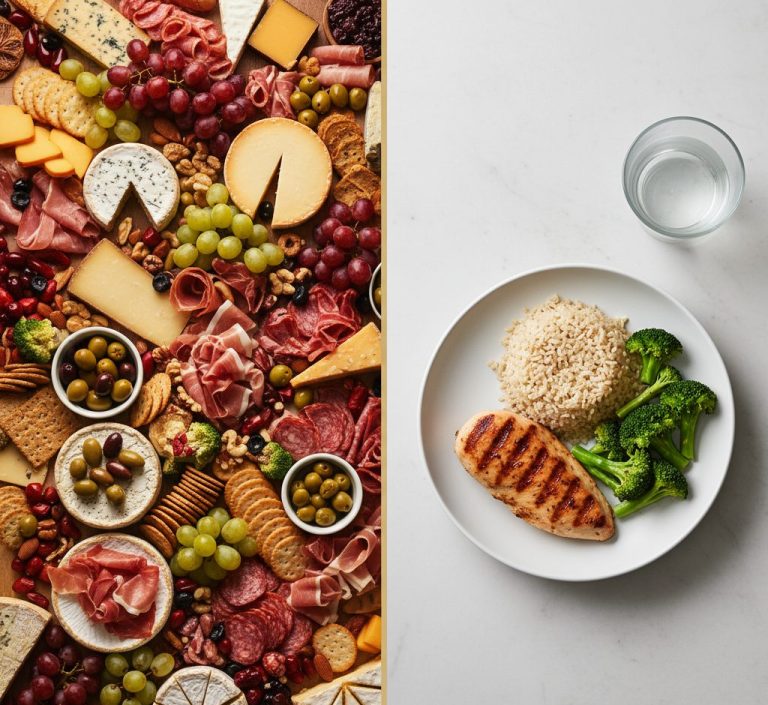
Most people assume lasting weight loss comes down to willpower. But for over 2,000 people in the National Weight Control Registry, the real secret might be something quieter: boredom.
They didn’t feed themselves a parade of new diets or constantly explore new recipes.
Instead, they kept a small set of go-to meals, repeated them, and removed many opportunities to overeat.
That repetition didn’t feel heroic. It made the healthy choice the easy choice.
It’s the opposite of what Instagram diet culture is selling you, and the research shows it actually works.
This is for anyone who has lost weight and wants to keep it off, especially if you’re tired of complicated meal plans. If you’ve ever felt trapped by the idea that eating healthy means variety, here’s something that might set you free.
Simplicity Is a Weight Loss Superpower
Here’s what the research says in plain language: people who successfully lose weight and keep it off for years eat from a much smaller menu than you’d expect.
Not restrictively small. Not sad or suffering. But intentionally limited.
The same basic foods, over and over. And that’s not incidental to their success. It’s central to it.
The National Weight Control Registry studied 2,237 people who lost an average of 70 pounds and kept that weight off for over six years.
These aren’t people temporarily forcing their way through a diet. These are people who fundamentally changed how they eat and made it work.
When researchers looked at what they actually ate compared to people who had recently lost weight but hadn’t maintained it, one striking pattern emerged: the successful maintainers consumed far less variety, especially in high-calorie food groups.
They weren’t deprived. They were strategic.
So the takeaway is simple: if you’re trying to lose weight and keep it off, stop thinking about adding more variety to your plate. Start thinking about intentional simplification instead.
What the Research Discovered About Variety
Researchers counted how many different foods people ate within food categories: proteins, dairy, grains, vegetables, fruits, fats, oils. Not calories. Not portion sizes. Just variety.
The finding was clear: the maintainers ate far fewer different foods across most categories, especially in the high-fat, calorie-dense groups.
Here’s what that looked like in practice.
A recent weight loser’s protein rotation might be: chicken breast, ground turkey, salmon, tilapia, lean beef, pork tenderloin.
A long-term maintainer’s rotation: chicken and maybe fish. That’s it.
The same principle applied everywhere—oils, cheeses, condiments, fats. The maintainers weren’t just eating less total food. They were eating less different kinds of food.
The effect was strongest in high-fat food groups. This makes sense. Calorie-dense foods are where variety becomes dangerous.
A long-term maintainer might have one cooking oil and one type of nut.
A recent weight loser might cycle through five different ones.
Each feels like a fresh choice. Each one can trigger the reward system in your brain that says “try more.”
One thing to note: there was no significant difference in variety when it came to fruits and combination foods. This isn’t about eating the same sad salad forever.
It’s specifically about calorie-dense categories where novelty drives overconsumption.
How This Applies to Your Diet Struggle
If you’ve lost weight but can’t maintain it, here’s the hard truth: stop trying to make your eating interesting.
I know that sounds depressing. Food is supposed to be an adventure. An exploration. Proof that you’re living well.
Food blogs, cooking shows, and wellness influencers all say the same thing: healthy eating means discovering new recipes and expanding what you eat.
But what 2,000 successful weight loss maintainers are actually showing you is different.
This constant exploration and variety-seeking? It might be exactly what makes long-term maintenance impossible for you.
Here’s what happens in your brain: novelty keeps you engaged and wanting more.
When you eat the same food repeatedly, your brain gets bored and you feel satisfied sooner.
When you keep trying different flavors, textures, and cuisines, your brain stays interested and keeps pushing for more.
That’s why you can finish an entire charcuterie board at a party but might stop eating the same cheese on its own.
Imagine your appetite as a novelty-seeking animal. Give it one familiar food and it settles. Show it a buffet of new foods and it gets restless.
Successful weight loss maintainers have figured this out. They’re not fighting their brains through willpower. They’re using how their brains actually work against the problem.
By eating the same foods—especially the high-calorie ones—they’re basically turning down the volume on their brain’s desire to overeat.
This doesn’t mean chicken and broccoli for the rest of your life. It means finding a core set of foods you genuinely enjoy, that fit your schedule and body, and building your eating around those.
Let other people chase food trends and Instagram recipes. You’ll be the one who actually looks the same at the reunion.
How the Brain Reacts to Fewer Food Options
Let’s break down why this approach works so well, because understanding the mechanism makes it easier to stick with.
When you have unlimited options—especially in calorie-dense categories—you’re constantly deciding. Chicken or fish? Olive oil or avocado oil? That cheese or this one?
Each decision drains your mental resources. It’s called decision fatigue, and it adds up throughout the day.
By evening, you’ve already spent your decision-making budget on breakfast, lunch, and snacks.
There is nothing left for the hard choices.
But there’s something deeper happening in your brain.
Your brain treats novel foods differently than familiar ones. Novelty activates your dopamine system. Your reward pathways light up.
Eat something new, and your brain feels pleasure and wants to experience it again.
From an evolutionary angle, this made sense—food variety meant you got complete nutrition when food was scarce.
In an environment where food is everywhere and engineered to be addictive, this novelty-seeking becomes a liability.
When long-term weight loss maintainers consciously limit variety, multiple things happen at once:
They reduce daily decisions and preserve mental energy for what matters. Saying no to office cake. Making good choices when you’re hungry and tired.
They turn down the volume on the novelty reward system. Once a food stops being new, it loses its pull. You can eat it without obsessing.
They build unconscious habits. Eat the same breakfast three hundred times, and it becomes automatic. Habits bypass willpower entirely. You’re not deciding anymore. You’re just doing.
They create predictable calorie intake. When you know exactly what you’re eating, hitting your targets becomes straightforward.
It’s like budgeting money. Far easier with set recurring expenses than constantly spending on different things.
The successful maintainers aren’t suffering through deprivation. They’ve solved the willpower problem by changing their environment and habits. That’s the real strategy.
False Beliefs That Undercut Weight Maintenance
Several common beliefs about eating and weight loss fall apart when you look at the data.
Myth 1: “You need variety to get complete nutrition.”
You do need nutritionally complete food. But that’s different from needing 15 different protein sources or 10 vegetable varieties.
The registry participants ate a monotonous diet that was still nutritionally adequate. A chicken breast, eggs, broccoli, brown rice, and an apple cover enormous nutritional ground.
Completeness and variety aren’t the same thing. Vary your vegetables and fruits freely. Keep your treats and high-calorie items simple.
Myth 2: “Eating the same food daily will make you binge when you break.”
The evidence says otherwise. These registry participants maintained their weight for six years.
If the structure were creating psychological pressure that eventually exploded into binges, we’d see evidence of cyclic weight regain. We don’t. What we see is stability.
The “breaking point” narrative is often used to justify constant dietary exploration. But the research shows that structure, not exploration, predicts long-term maintenance.
Myth 3: “Restricting variety is just another form of restrictive dieting.”
This distinction matters. This isn’t about eating fewer calories or less food. It’s about eating less different food within categories.
Registry participants ate normal portions of normal foods. They just weren’t trying four types of fish or rotating through five oils.
The restriction was in variety, not in quantity or satisfaction.
Myth 4: “These people must have special genetics or metabolism.”
The data contradicts this. These aren’t special people with special bodies. They’ve made intentional choices about how they structure their eating.
Those choices happen to align with how human brains respond to food in an environment of abundance.
A Practical Guide to a Boring Diet
This research translates into real action. Here’s exactly what to do.
Step 1: Audit Your Current Pattern (This Week)
Spend three to five days noticing what you eat. Don’t change anything. Don’t obsessively journal. Just pay attention.
How many different proteins do you rotate through? Vegetables? Fats or oils? Grains?
Write them down.
This isn’t about judgment. You’re seeing where unnecessary complexity actually exists in your eating.
Step 2: Identify Your Anchor Foods (Pick 2-3 Per Category)
Look back at what you found. Which foods did you actually enjoy and reach for anyway?
Pick two or three proteins you genuinely like (not healthy foods you tolerate). Two or three vegetables you’d actually eat. Two or three grains. One or two cooking fats.
These become your anchor set. These are your foundation.
Step 3: Build Your Week Around These Anchors (Start This Week)
For the next two weeks, plan your meals around these core foods.
Yes, you can still eat other things. But make 80 percent of your eating come from this smaller set.
You’ll notice something immediately: meal planning gets faster, shopping gets simpler, and you may eat less randomly throughout the day.
Step 4: Add Back Minor Complexity Slowly (After Two Weeks)
Once you’re comfortable with your anchor foods and have felt how easy simplicity is, you can cautiously add back a protein or a vegetable.
Do this consciously. You’re not recreating chaos. You’re maintaining simplicity while testing what works.
Step 5: Notice What Shifts (Track the Intangibles)
As you simplify, pay attention to what becomes easier. Decision fatigue drops. Meal prep becomes mindless. Food stops being something you think about constantly.
That freed-up mental space is the real win. Use it for something that matters.
Why I Trust Simplicity Over Hype
I’ve watched hundreds of people fail and succeed at weight loss. There’s almost always a turning point. It’s when they stop trying to optimize and start trying to sustain.
The optimization phase—tweaking macros, exploring recipes, experimenting—works for maybe three to six months.
Then friction piles up. You’re tired. You’re making more decisions. You’re vulnerable.
The people who break through that wall almost always simplify. They find what works and they let it be boring.
And here’s what surprised me: they don’t resent the boredom the way you’d expect. After a few months, it becomes freeing.
You stop negotiating with yourself about what to eat. You just eat.
That’s when weight loss stops feeling like an act of willpower and becomes how you simply live.
I think our culture has done people a real disservice by romanticizing food as entertainment and treating eating as self-expression.
Food is important. Eating can be enjoyable. But it doesn’t need to be interesting to be satisfying.
Some of the most resilient, consistent people I know have genuinely boring diets. They just don’t talk about it publicly. Boring doesn’t get engagement on social media.
Clinically, I see this work more than I expected.
But, it’s not magic. Some people react badly to extreme repetition. If monotony triggers urges for you, don’t force this. Use it as one practical tool among several.
When Simplicity Might Not Fit Everyone
This research is solid, but it has real limitations. Not to undermine the findings, but so you know how to use them effectively.
First: this is observational research. It shows that people who maintain weight loss eat with less variety.
But it doesn’t prove low variety caused the successful maintenance. It’s possible people naturally inclined toward simplicity both eat simply and maintain weight for other reasons.
We can’t prove causation definitively. That said, the biological mechanism makes enough sense that it’s worth testing in your own life.
Second: the registry includes people motivated enough to join and stay engaged with tracking their weight. There’s selection bias.
These aren’t random people. They’re already the type inclined toward structure.
But here’s the thing: if you’re trying to maintain weight loss, you probably want to become that type of person anyway. So this is relevant to you.
Food questionnaires have known limits too. Treat this as useful, practical evidence, not a universal rule.
Third: the study doesn’t explore deeply why people chose lower variety.
Was it conscious strategy? Unconscious habit? Preference? Necessity? Boredom? Intention?
We don’t know. Which means when you implement this, you might need to find your own reasons to embrace simplicity rather than experiencing it as deprivation.
None of these limitations invalidate the core finding. Think of this research as strong evidence to test in your own life, not as absolute truth.
Some people might thrive with slightly more variety. But if you’ve struggled with consistency in the past, this is absolutely worth trying.
Why Structure Beats Novelty Over Time
Losing weight is hard. Keeping it off is significantly harder.
If you can eliminate some friction—fewer decisions, less novelty-seeking, less constant planning—you make the harder part more sustainable.
Two thousand people who have actually kept weight off long-term suggest that embracing a simpler, less varied diet is one of the most powerful ways to do that.
You don’t need a perfect diet. You need a sustainable one. And for most people, sustainable looks far less interesting than Instagram suggests.
Start this week: identify your anchor foods. Build your meals from them. Watch how much mental space opens up. Then decide whether this feels like restriction or relief.
My prediction: after a few weeks, you’ll realize it feels like freedom.
The people in the Weight Control Registry didn’t fail at weight loss maintenance because they got bored. They succeeded because they did.
Stop Guessing — Start Doing
There’s a specific kind of relief that comes with knowing exactly what works. Most people keep trying harder and doing more, wondering why it still doesn’t stick. The people who succeed do the opposite.
Every week, we send one email that shows you exactly what the research says about long-term weight loss maintenance.
No trends. No complicated protocols. No Instagram fantasies. Just real patterns from real people who’ve kept the weight off, decoded into something you can actually use this week.
If you’re tired of guessing and ready to stop circling back to the same problems, this is for you – sign up below.